Human CJC-1295 research
The long-acting form produced several distinct blood findings. Laying them out separately makes the result more interesting, and more exact.
Teichman: hormone levels and duration
In Teichman and colleagues’ healthy-adult studies, participants were aged 21–61. Single subcutaneous doses of 30 or 60 micrograms per kilogram produced dose-dependent increases in mean growth hormone of 2- to 10-fold for 6 days or more. IGF-1 rose 1.5- to 3-fold for 9–11 days. These are the study's amounts and observations.
The estimated CJC-1295 half-life was 5.8–8.1 days. After multiple doses, IGF-1 remained above baseline for up to 28 days. Half-life describes the time for half the compound to clear; it gives the long-acting design a measurable description.
I regard that duration as the paper's central achievement. A claim about better sleep would require a sleep result, and these hormone measurements leave that work ahead.
Ionescu and Frohman: the pulses continued
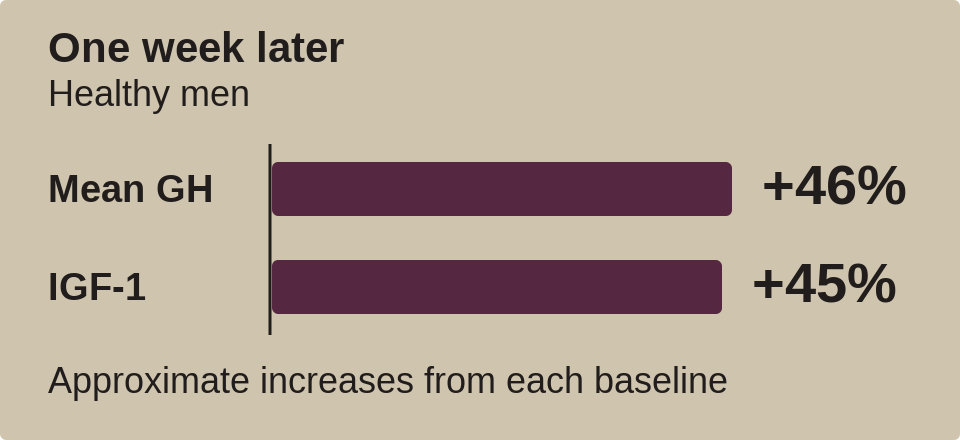
The pulsatility experiment in healthy men aged 20–40 used a single subcutaneous dose of 60 or 90 micrograms per kilogram. One week later, basal growth hormone was approximately 7.5-fold higher, mean growth hormone was about 46% higher, and IGF-1 was about 45% higher.
Basal means the lower level between bursts. The frequency and size of the bursts stayed unaltered. I expected the long-lived stimulus to flatten the pattern; the finding was more subtle, with extra background secretion alongside continuing pulses.
Preserved pulses help describe how the gland responded. The study's endpoints still leave sleep, exercise recovery and long-term health unanswered.
Sackmann-Sala: other blood proteins
The serum-protein study in 11 healthy young men widens the picture. It reported decreases in apolipoprotein A1 and a transthyretin isoform, alongside increases in an albumin fragment and immunoglobulin/beta-hemoglobin species. The immunoglobulin and albumin-fragment signals correlated with IGF-1.
Those were candidate markers of hormone-system activation. For a blood-chemistry study, the breadth of the response surprised me. The protein changes alone leave their clinical meaning unresolved; an increased immune-protein signal cannot diagnose an adverse immune reaction.
CJC-1295 and ipamorelin
The combination brings together a GHRH analogue and a secretagogue acting through the ghrelin pathway. Their different receptor actions provide a rationale for greater growth-hormone release together. Controlled human efficacy data for this particular pair remain limited.
Raun’s early ipamorelin work involved animals and rat pituitary cells in a dish, reporting selective growth-hormone release with little effect on stress hormones or prolactin. Rodent bone-formation work also tested ipamorelin. Neither supplies a human outcome trial of CJC-1295 paired with ipamorelin.
For me, complementary receptors are a starting point for testing a recovery benefit. That argument needs people receiving the actual pair and health outcomes measured in those people.